From Tool & Die to Lasers: A Fabricator's Journey
GK
Hey Laser Freedom folks — Scott here. George invited me to introduce myself, so here goes.
Quick background: I've been in manufacturing my whole career, 25+ years as a journeyman tool and die maker in Illinois, Texas and now Wisconsin — metal stamping, tooling design, die maintenance, and various manufacturing leadership roles. These days I manage a manufacturing operation by day, but the fun stuff happens in my home shop in Lake Geneva. Over the years it's grown into a 200W MOPA fiber, a 80w CO2 laser, a Shapeoko 3xxl CNC router (that does have a 7w Jtech Photonics Diode head attachment rarely getting used these days), and a creality K2 Plus multi-color 3D printer. My wife Lizzie, our three kids, and our Maltipoo Charlie tolerate the noise.
What I wish I'd known starting out
Even with a quarter-century of tooling experience, lasers humbled me. My biggest mistake early on was guessing at settings instead of testing systematically. If I could start over, I'd burn test grids on every new material from day one and log everything. The gap between a cool piece of art and the exact parameters to execute it on a specific material is where most beginners get stuck. Every machine talks to material a little differently, and there's no shortcut around learning yours.
On the "which laser should I buy" question
Since this comes up constantly in the group, here's my honest take after running most of these machine types. Full disclosure up front: I now sell machines under my own Reticle brand as a partner, not a manufacturer of the machines themselves, so weigh my opinions accordingly — I'll try to be straight about where competitors win.
Diode lasers (xTool, Sculpfun, Atomstack) are the cheapest way in. Great for wood, leather, slate, coated metals. Slow, and they won't do serious work on bare metal, but for under $1K you learn the whole workflow. xTool's software is genuinely more beginner-friendly than most — credit where it's due.
CO2 (OMTech is the value king) is the workhorse for organics — wood, acrylic, glass, fabric. Faster than diode, bigger beds, but you're maintaining mirrors, alignment, and a water-cooled tube.
Fiber and MOPA are where metal work lives. A MOPA marker like the ones I run (I sell a desktop SFM60/SFM100 that color-marks stainless and anneals black on aluminum) opens up jewelry, electronics, tumblers, firearms — anywhere permanent metal marking matters. ComMarker and OMTech both make capable fiber markers too, and depending on budget one might be the better fit for you.
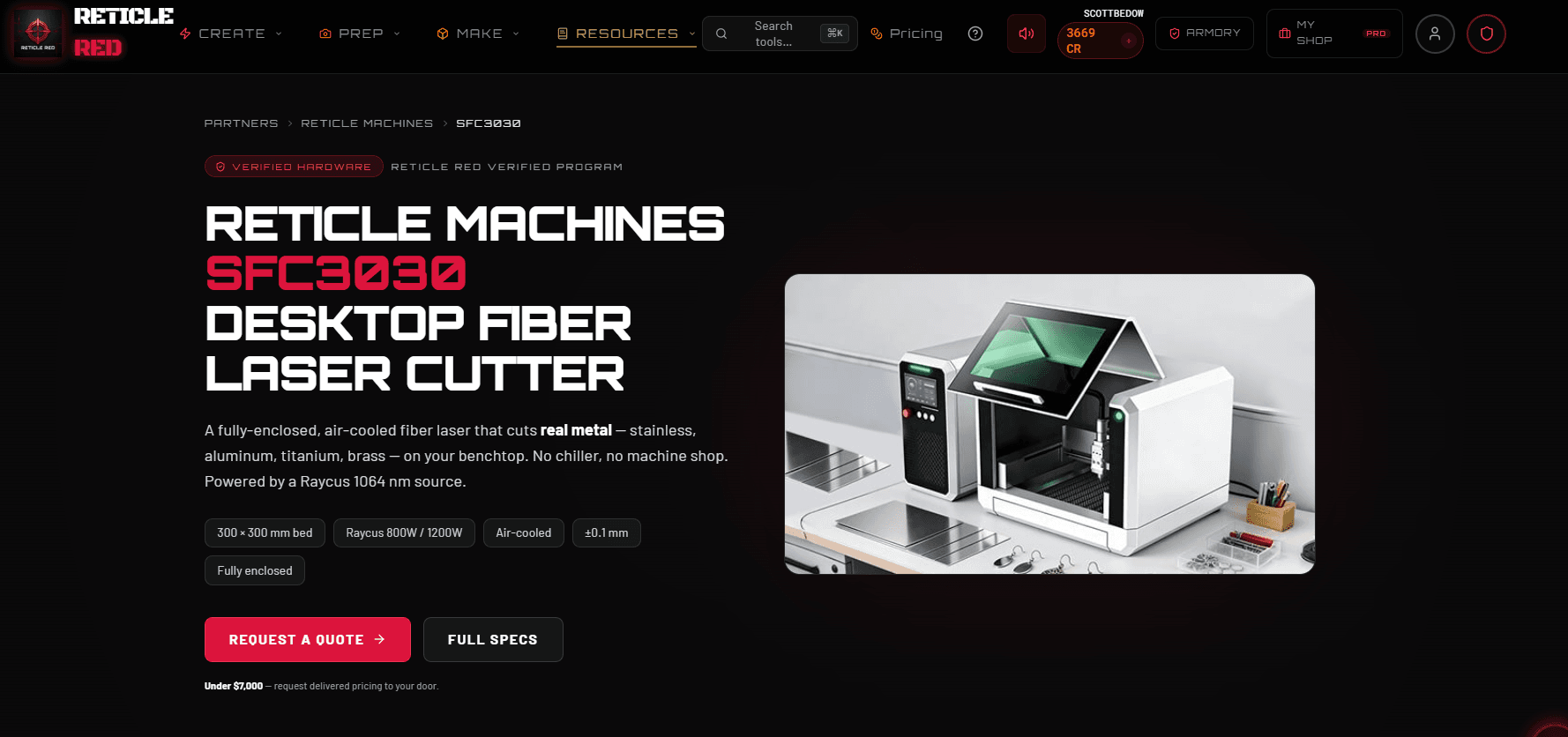
The machine I'm most excited about, though, is the SFC3030 desktop fiber cutter. For years, actually cutting stainless, aluminum, titanium, or brass meant a full industrial machine or sending parts out. This is a fully enclosed, air-cooled benchtop unit — Raycus 1064nm source in 800W or 1200W, 300×300mm bed (500×500 optional upgrade), ±0.1mm positioning, about the footprint of an A3 laser printer. Real numbers: the 800W cuts up to 2mm stainless, 1.5mm aluminum, 1mm brass; the 1200W does 3mm stainless, 2.5mm aluminum, 1.5mm brass. No chiller or coolant plumbing — you need a 220V single-phase outlet (think dryer/welder plug, not a special install) and a compressed-air line. Under $7K, roughly 20-day lead time, 1-year warranty with lifetime tech support. It's not for everyone: if you only work wood and acrylic, a CO2 is still your machine; you need an air compressor; and a 300×300 bed means small parts, not sheet work. But if you've been engraving tumblers and want to start cutting your own blanks, badges, or hardware in-house, this is the tool I wish existed when I started. Happy to answer any spec questions in the comments.
Rounding out what I carry: a battery-powered handheld dual-laser (1064nm fiber plus 455nm blue in one unit — metals *and* wood/leather with no computer or chiller, handy for marking things too big for an enclosure) and the SFW1200, a 1200W air-cooled handheld fiber welder with wire feeder for anyone doing fab work on stainless, aluminum, or carbon steel.
There's no "best" laser — there's the best laser for what you actually make. That's why I love that George built a place where we can talk about this stuff freely.
The software itch
The thing that kept bugging me was the art-to-parameters gap. I'm a machinist, not a programmer, so I'll admit AI tools helped me write a lot of the code — but I ended up building reticle-red.com, a platform for generating art that's actually optimized for engraving, with a built-in assistant that suggests starting parameters for your material and machine. It's homemade and rough in spots, and honestly the most useful thing this community could do is tell me where it falls short. If anyone wants to kick the tires, I'd rather hear what's broken than what's good.
When I'm not in the shop, I write about manufacturing tech at diehardamericanmetal.com.
Glad to be here — looking forward to seeing what everyone's burning.