SIZE MATTERS - Uv Lens Considerations
GK
You’re here because you’re not an idiot or space alien!
You’re not buying “a cool laser toy.” You’re buying a machine to make real money with, and you actually care how the thing works. You’re the person who reads specs, not just watches TikToks of flying sparks. You believe engineering matters—and that’s exactly why you found Laser Freedom: we exist to share the basic engineering everyone else politely skips over.
So let’s talk about the one boring, unsexy part that quietly controls your entire business model:
The lens.
Not the wattage. Not the purple LEDs on the side of the case.
The field lens that decides how big you can actually engrave.
The sad truth: your “work area” is lying to you
Machine listings love to shout things like:
“30W UV LASER – INDUSTRIAL GRADE!”
“MARK ANYTHING! ANYWHERE! FOREVER!”
Cool story. But here’s what really matters: every galvo UV system is chained to one simple number—the size of the lens field.
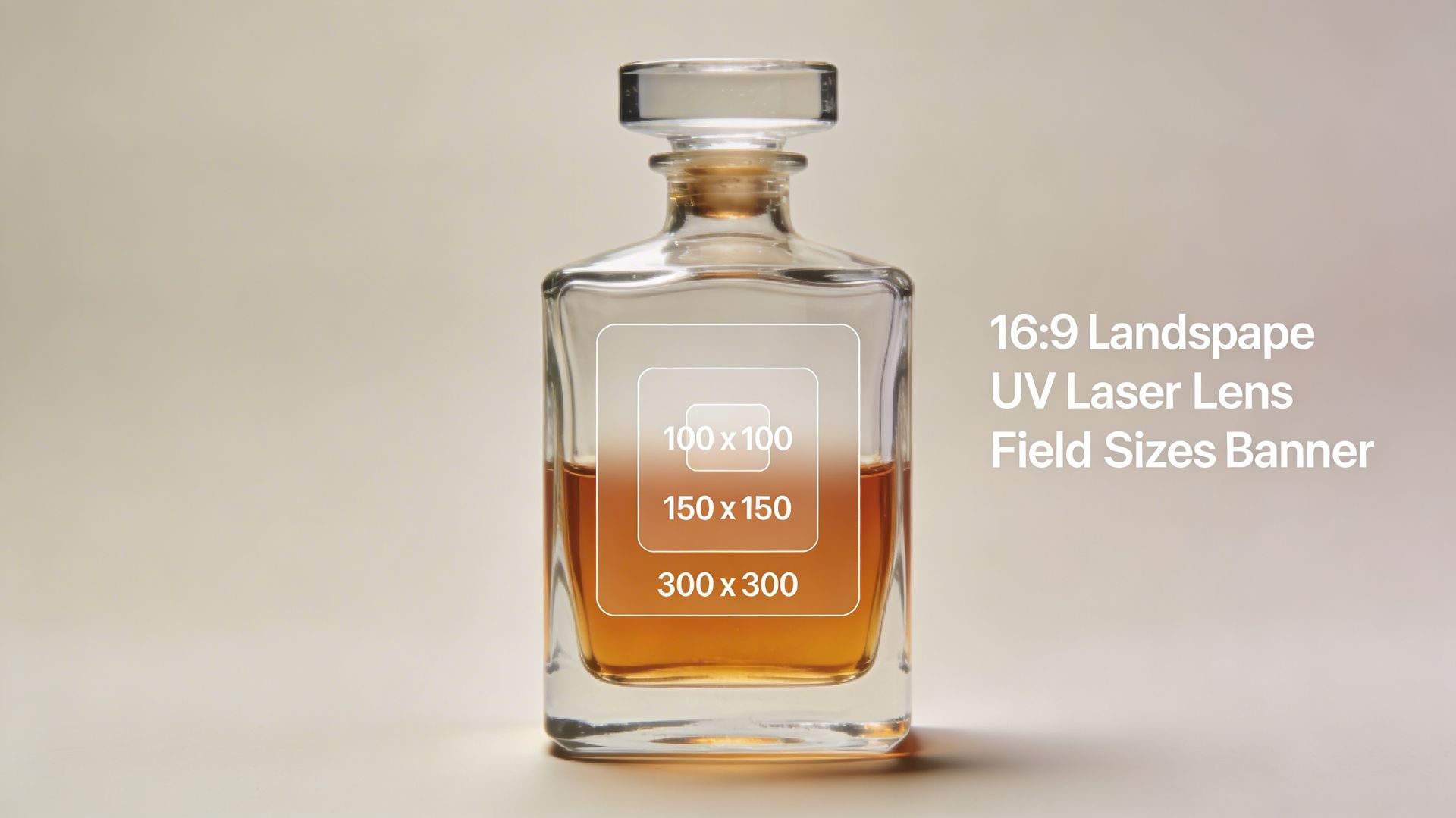
If the lens is 100 × 100 mm, your real world is about 4 × 4 inches.
150 × 150 mm? You’ve got about 6 × 6 inches.
300 × 300 mm? Around 12 × 12 inches.
That’s it. That’s the kingdom. The laser beam does not magically grow longer because the marketing department got creative.
If you want to engrave flat whiskey decanters, awards, cutting boards, or panel signage, the lens field is your hard ceiling. If the artwork doesn’t fit inside that box, you’re:
Shrinking the design and killing the wow factor
Doing multi-position jobs and praying your alignment is perfect
Or telling the customer, “Yeah, we can’t do that.”
So when a seller brags, “This machine engraves up to 300 × 300 mm,” what they’re really saying is, “We put a 300 × 300 lens on it.” That’s the whole trick.
The machine isn’t magic. The lens is the bouncer at the door.
“Just get the biggest lens” — famous last words
If you’ve ever been in a laser forum, you’ve seen this advice:
“Bro, just get the biggest lens you can afford. More is better.”
That’s like saying, “Just put tractor tires on your sports car; bigger wheels are better.” Sure. If you hate turning and stopping.
Here’s the catch they don’t tell you:
To stretch the marking field, the lens has to bend the beam further out to hit the corners. As that field grows:
The spot size gets larger – your crisp little dot becomes more of a marshmallow.
Fine detail gets mushier – tiny fonts and thin lines on glass lose that razor look, especially near the edges.
Power density drops – same wattage spread over a larger area means less energy per unit area, which glass absolutely notices.
On a nice, tight field, your UV can engrave glass with a beautiful frosted finish that looks high-end and intentional. On an overly large field, the exact same laser source can start to feel like it’s drawing with a slightly dull pencil.
So yes, that 400 × 400 mm lens looks heroic in the product photos.
But if your real business is tight logos on whiskey decanters and high-end glassware, you might have just traded away the very thing your customers are paying for: sharp, clean detail. Know what you want to engrave. The decanter business is good as are glass trophies!
What size lens do working shops actually use?
Let’s translate engineering into money.
Think in terms of: “What am I engraving, and what am I charging for?”
100 × 100 mm field (≈ 4 × 4 in)
Great for logos on glasses, tumblers, and small tags. Ideal for tight, detailed work. Terrible for full-face decanter fronts.
150 × 150 mm field (≈ 6 × 6 in)
The grown-up choice for glassware. Enough room for a logo, monogram, and name on a decanter face, while keeping the spot small and the letters sharp. This is where a lot of serious “glass + money” work lives.
300 × 300 mm field (≈ 12 × 12 in)
Good if you want to fixture multiple pieces or engrave larger panels and awards. You start trading a little edge-to-edge sharpness, but you gain flexibility. Smart if your product mix is varied.
400 × 400 mm and up (≈ 16 × 16 in and beyond)
This is “I do big panels and don’t care about tiny serif text” territory. It’s not “I do delicate logos on crystal whiskey decanters and charge premium pricing” territory.
If your revenue is coming from elegant barware, awards, and premium glass gifts, chasing a giant field lens “just because” is like putting a tow hitch on a Ferrari. Technically possible. Strategically dumb.
Why decanter people should care (a lot)
Engraved whiskey decanters and glassware are a big deal right now. Not in the “grandpa in the basement” way. In the “weddings, corporate gifting, and ‘I want my bar to look expensive’” way.
The customer expectation is simple:
The engraving is centered and well-sized
The lines are crisp and consistent
The piece looks like it came from a high-end gift shop, not a flea market
You can’t deliver that reliably if:
Your lens field is too small, and you’re constantly scaling designs down so they “fit”
Or your lens is so big that your detail gets soft and hazy, especially on fine fonts and thin strokes
A smart shop owner asks:
What’s the largest real engraving area I need on a decanter face?
What lens size covers that area with room for positioning—not marketing bragging rights, but actual clean margins?
What spot size and detail level will make my product photos and closeups look expensive?
You don’t want the biggest lens.
You want the most profitable lens.
The Laser Freedom way to think about this
Around here, we don’t worship specs. We dissect them.
When you look at a UV machine, ask this:
What is the lens field size?
What’s my true usable engraving window on glass?
Does that match the products I want to sell at the prices I want to charge?
If the answer is “I don’t know, but the ad said it was 30W so it must be good”… you’re shopping like a hobbyist, not a business owner.
You’re on Laser Freedom because you already know better. You care that:
Bigger fields trade off detail
Lens choice locks in your maximum product size
Good engineering equals fewer headaches and more profit over time
You’re not just trying to get a laser. You’re trying to get the right laser, with the right lens, for the work that pays your bills.
Get the best tool for the job, engineering matters. Trust but Verify!
Looking to buy and UV and have more questions ,feel free to reach out to us. [email protected]