UV Lasers and glass spheres. You have to cut a Plane
GK
Advance UV Laser Research - What I have learned about engraving in spheres.
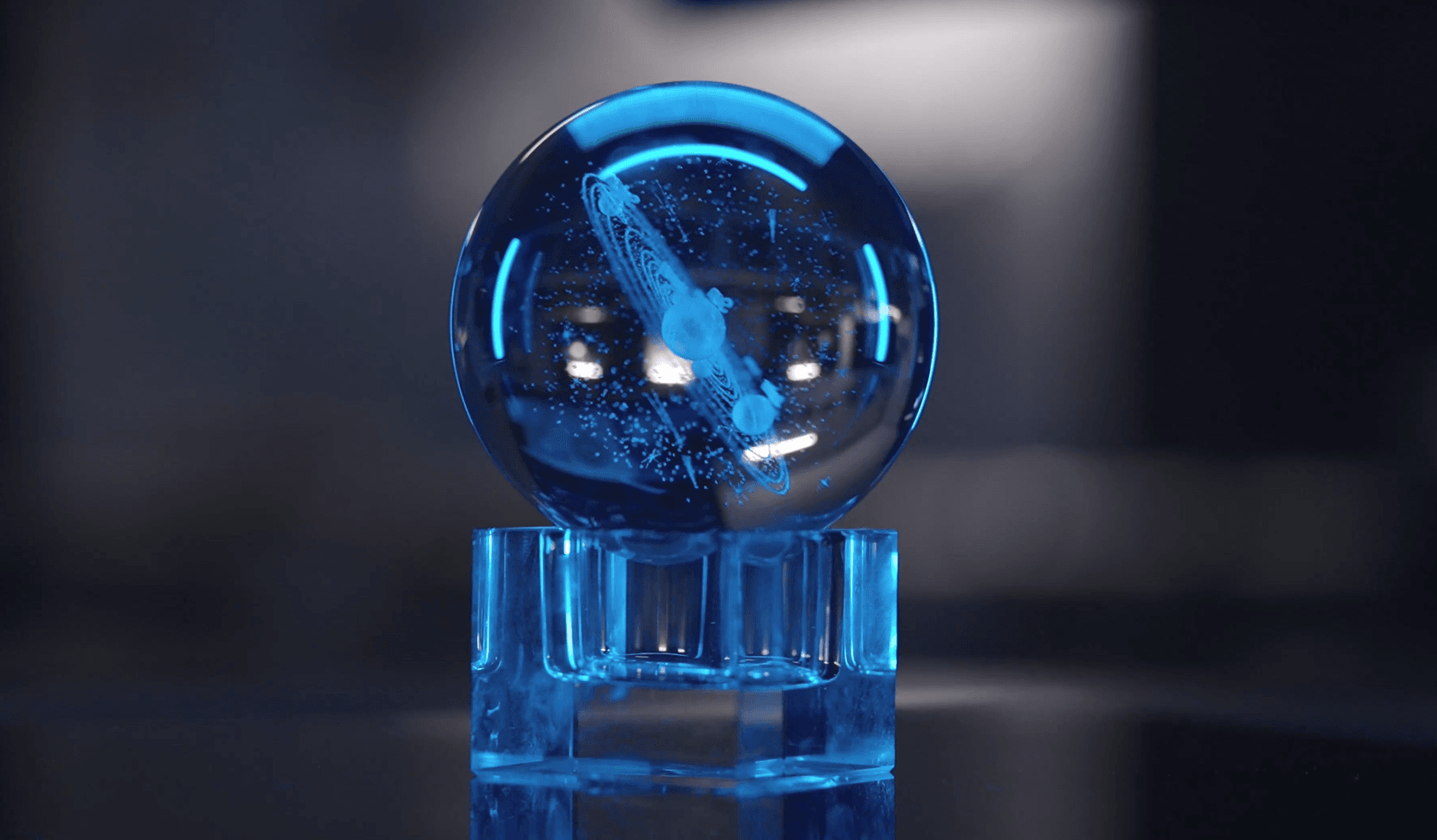
If you’ve made it this far, congratulations—you’re already ahead of half the people who buy lasers and think they’re going to engrave microscopic masterpieces straight out of the box. Let’s get one thing out of the way right up front: UV sphere engraving is an education experience. Not college. Not community college. More like that one shop class where the teacher warned everyone twice, sighed deeply, and then let you learn the hard way. Every laser wavelength has a learning curve, and UV just happens to have a curve with altitude. So if you’re the type of person who doesn’t like learning—or thinks the machine should just “figure it out”—please step aside and go engrave a coaster. The adults are talking.
And before you fall in love with the idea of engraving gorgeous little crystal planets, let me give you the second disclosure: you’re going to burn some blanks. Yes, you—future UV owner, proud researcher, brave traveler of the 355 nm path. You are going to sacrifice a few spheres to the Laser Gods. They’re going to chip, fracture, crater, sparkle, or develop patterns that look like your laser sneezed on them. This is not a design flaw. This is simply how physics greets new UV users. So take a breath, keep the receipts, and order extras. Once that’s out of the way and you’re not scared off, let’s talk actual engraving mechanics.
So here’s the deal with glass spheres: they are curved, optically unpredictable little gremlins that bend UV light in every direction except the direction you want. A sphere is basically a lens pointed back at the laser—and your poor beam has to enter that curved surface at the correct angle, with the correct stability, or it scatters like a flashlight bouncing off a disco ball. That’s why you’ll see everyone talking about “special fluid.” Don’t worry, it's not alien plasma or CerMark in disguise. The magic potion is usually nothing more than a glycerin-based medium or an optical coupling gel—the same stuff used in fiber optics or medical ultrasound. Its job is simple: create a temporary flat optical interface so the laser doesn’t freak out. It makes the beam behave, reduces the scatter, and stops the sphere from exploding into shiny confetti.
Now, if you’re the rebellious type who wants to know if you can skip the fluid altogether, technically yes—but prepare for disappointment. You can polish a tiny flat spot on the sphere (ruins the aesthetics), engrave coated or frosted spheres (great, but not optical-grade), or use a sub-surface 3D engraving machine (only $8k–$40k). You can even experiment with a water film while the sphere gently rotates. Will it work? Kind of. Will it look like professional UV engraving? Absolutely not. The fluid exists for a reason, and the reason is physics laughing at your confidence.
Once you accept the gel as your new best friend, the practical recipe is simple: apply a thin, even film, run 20–40% power on your UV laser, crank the speed to 400–800 mm/s, and don’t be afraid to do a light cleanup pass at low power. Rotate the sphere 2–5 degrees between passes. This tiny move—barely a twitch—overlaps the microfacets and improves clarity more than any setting on the machine. Most people forget this and then blame the laser manufacturer, the beam quality, the alignment, the controller, the firmware, the weather, or the moon phase. But no—it's usually the rotation trick.
So there it is. UV sphere engraving, boiled down to the truth with just enough sarcasm to keep your expectations realistic. If you can embrace the learning curve, enjoy a little trial and error, and aren’t afraid to burn a few K9 spheres while you dial in your technique, you’re going to love the kind of detail a UV machine can produce. But if you thought this was going to be push-button perfect from day one… well, the coaster section is still open.
Laser Freedom does have a give away going on (December of 2025) we are giving away some interior engraved glass blocks. Just hit this link to go to the page and enter. We almost always have a give away going on look at the menu bar. Maybe you get LUCKY